Research
Research
The Miao Lab studies how cellular interactions are coordinated to build and mature the heart. We focus on three linked dimensions of this process: how cardiac cells exchange information, how cardiomyocytes integrate with the extracellular matrix to organize tissue, and how cardiac cell identities and functional states are specified and matured.
Together, these questions connect molecular and cellular mechanisms to the emergence of cardiac structure and function.
Across this continuum, we ask how communication, tissue organization, and cell-state programs are established, refined, and coordinated as the heart acquires its structure and mature functional states.
Intercellular Communication
How do cardiac cells exchange information across space to coordinate heart formation?
Current Direction
The Miao Lab investigates how direct communication between cardiac cell populations is established, regulated, and integrated with changing tissue architecture across heart development and maturation.
Published Foundation
In prior work, Miao and colleagues identified tunneling nanotube-like structures (TNTLs) that extend from cardiomyocytes to endocardial cells across the cardiac jelly. These actin-rich structures support direct long-range signaling and cytoplasmic protein transfer. Disrupting TNTL formation reduced signaling interactions and impaired trabecular and ventricular wall morphogenesis.
Cell–ECM Integration and Cardiac Tissue Organization
How do cell–ECM interactions shape cardiomyocyte behavior and organize the developing ventricular wall?
Current Direction
The Miao Lab investigates how cell–ECM integration and the physical organization of cardiomyocytes are established during development and remodeled as the heart matures.
Published Foundation
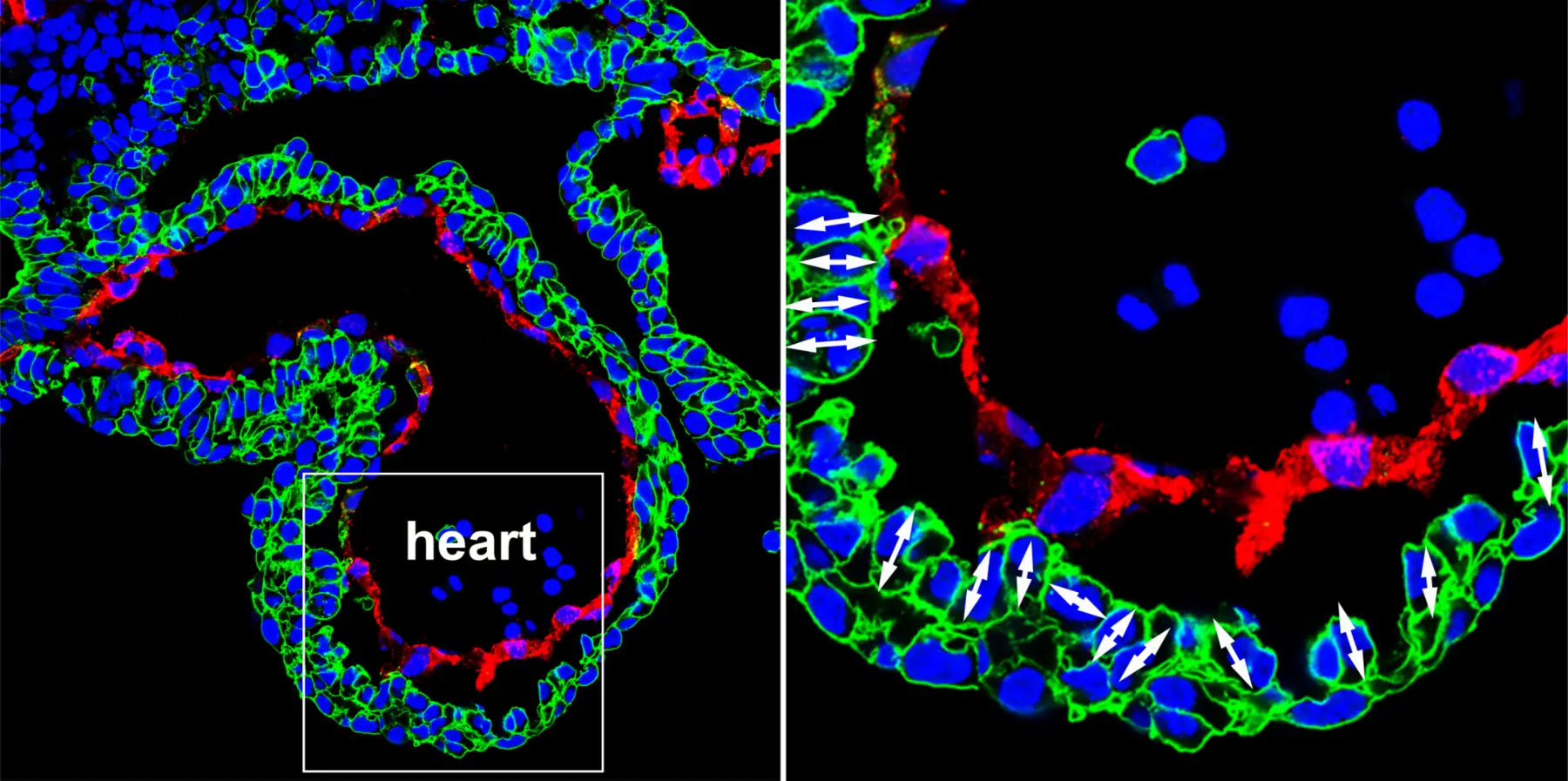
Prior work by Miao and colleagues showed that β1 integrins connect cardiomyocytes to an extracellular-matrix network that includes fibronectin and other ligands. Loss of β1 integrin disrupted cardiomyocyte shape, orientation, oriented cell division, migration, and cellular organization, preventing normal trabecular tissue architecture from forming.
Cell Identity, Fate, and Maturation
How are cardiac cell identities specified, diversified, stabilized, and matured as the heart develops?
Current Direction
The Miao Lab investigates how cardiac cell identities and functional states are specified, stabilized, and matured, and how these transitions are coordinated with tissue organization across development and maturation.
Published Foundation
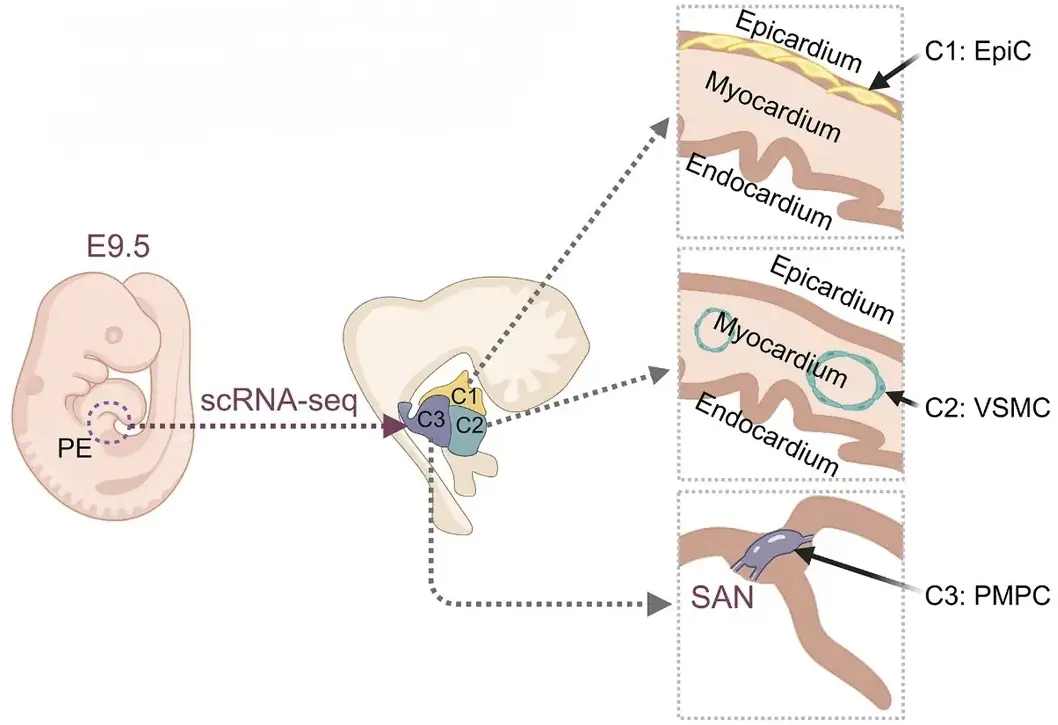
Prior work by Miao and colleagues combined single-cell transcriptomics, spatial validation, and genetic lineage tracing to resolve distinct progenitor populations within and adjacent to the pro-epicardial region. The study identified a vascular smooth muscle–like population that contributes to coronary vascular smooth muscle and a pacemaker progenitor population that contributes to sinoatrial node cells.
Approaches
The research program combines mouse genetics and lineage tracing with advanced imaging and single-cell approaches to connect molecular mechanisms with cell behavior, spatial organization, and tissue architecture.
- Mouse genetics
- Lineage tracing
- Advanced imaging
- Single-cell approaches
Why These Mechanisms Matter
Heart development depends on precise coordination across cells and tissues. When these processes are disrupted, cardiac structure can be altered, contributing to congenital heart disease. Understanding how communication, tissue organization, and cell-state maturation are established also provides a framework for understanding the limited repair capacity of the mature heart.
View our publications →